
9/9/2025
CSDL at CISBAT 2025: Parisa Najafian Unveils Smart Design Solutions for Outdoor Thermal Comfort.
On September 3rd, Parisa Najafian, a Ph.D. student in Civil Engineering and a member of CSDL, presented a paper entitled “A Data-Driven Framework for Optimizing Outdoor Thermal Comfort” at CISBAT 2025. The paper was co-authored with Arman Nikkhah Dehnavi and Prof. Farzad Hashemi. CISBAT is an international scientific conference held every two years, organized by EPFL/Smart Living Lab, and focuses on fostering a sustainable energy transition in the built environment.
Abstract:
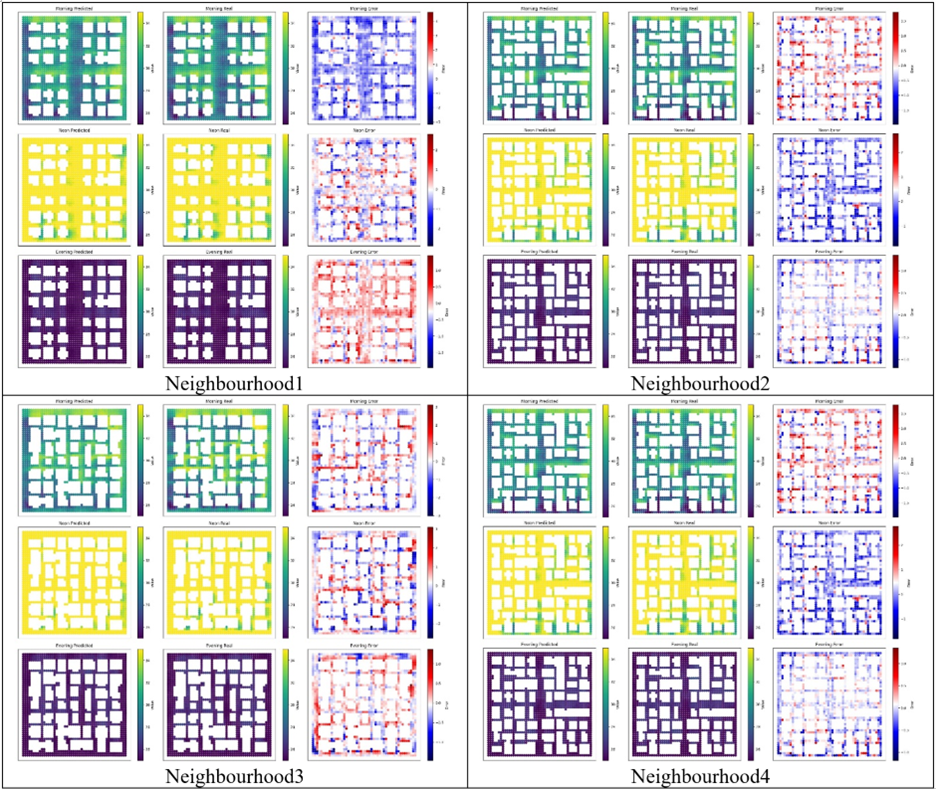
This study introduces a data-driven framework that empowers urban planners to enhance outdoor thermal comfort (OTC) by linking microclimatic conditions, such as shade, airflow, and heat retention, to design choices. By combining high-resolution environmental simulations, advanced machine learning models, and innovative Counterfactual Explanations (CFX), the framework not only predicts thermal comfort through the Universal Thermal Climate Index (UTCI) with high accuracy (with CatBoost performing best) but also reveals minimal, targeted design changes that can yield significant improvements. This approach provides actionable, data-informed insights for shaping cooler, more comfortable urban spaces.
7/10/2025
Quang V. Tran presented at ICUC12!
At the 12th International Conference on Urban Climate (ICUC12), Quang V. Tran presented our study titled “Data-Driven Urban Heat Mitigation: Integrating CFD and Machine Learning for Adaptive Cooling Strategies.” Delivered online, the presentation introduced our approach combining CFD simulations and machine learning to support heat mitigation in vulnerable neighborhoods, using San Antonio’s Westside as a case study.
5/5/2025
Mapping Injustice: Uncovering Urban Heat Disparities from Redlining in San Antonio.
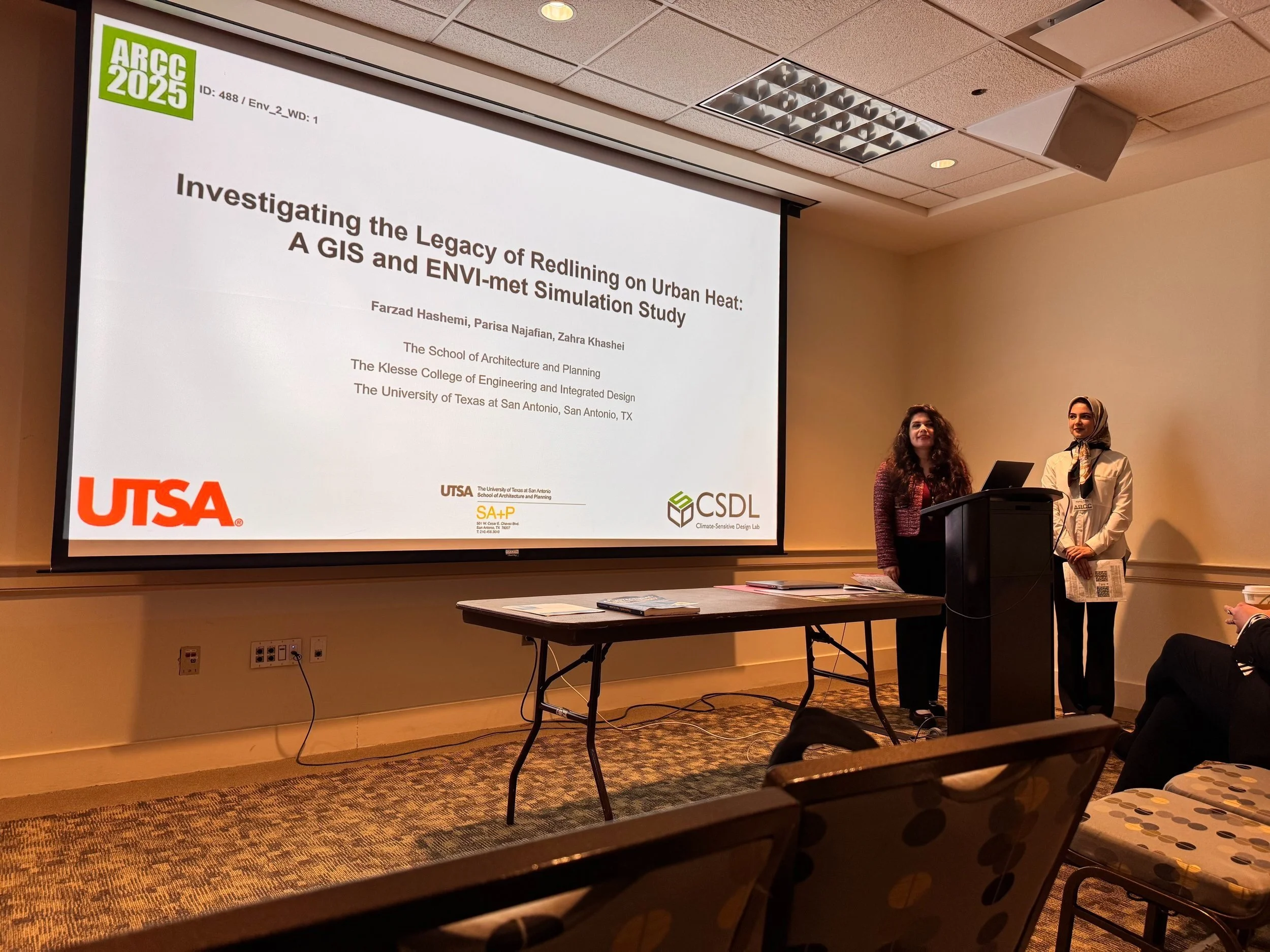
Assistant Professor Farzad Hashemi and Ph.D. students Parisa Najafian and Zahra Khashei attended the 2025 ARCC Conference in College Park, Maryland, from April 2–5, 2025, to present their research on the legacy of redlining and its impacts on urban heat.
Their study, titled "Investigating the Legacy of Redlining on Urban Heat: A GIS and ENVI-met Simulation Study," highlights how historically redlined neighborhoods in San Antonio experience significantly higher air temperatures due to land use disparities and lack of vegetation. The presentation contributed to broader discussions on environmental justice, urban microclimates, and equitable design strategies.